Selby—Rue Barrée
The King in YellowSelby—Rue Barrée is an unrequited attachment in which a single glance becomes, for Selby, the beginning of an extravagant emotional campaign. The relation is defined by asymmetry: Selby invests curiosity, imagination, money, and personal dignity, while Rue Barrée offers only brief looks, gestures, and a visible but unexplained reserve. Its comedy comes from the gap between the scale of Selby’s response and the slenderness of the contact that provokes it.
First Sight and Immediate Projection
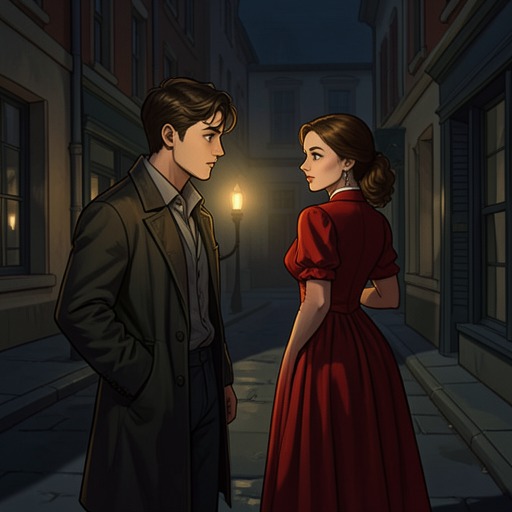
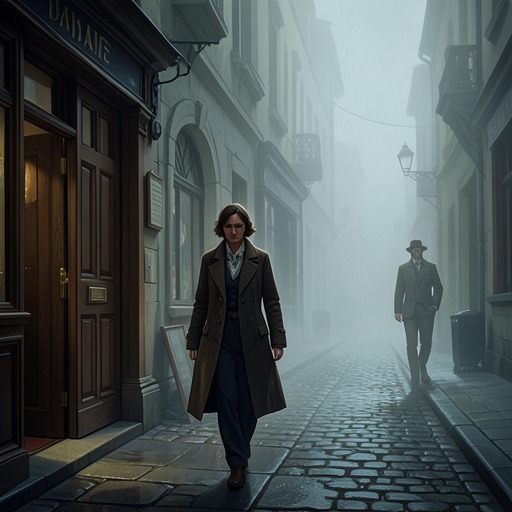
Selby first encounters Rue Barrée while walking with Clifford, Elliott, and Rowden toward the École de Médecine. She passes hurriedly at a street corner; the three older companions bow with an air of gloomy foreboding, and she returns the salute without raising her eyes. Selby, lagging behind because a shop window has caught his attention, looks up and meets two extraordinarily blue eyes. Rue Barrée drops them at once, and Selby hastens after the others, already altered by an encounter that has lasted only an instant.
When he announces that he has seen the prettiest girl, the others answer with the name Rue Barrée. Their reaction gives her an ominous reputation before Selby knows anything about her. The name functions almost like a warning or a spell: his companions’ collective gloom contrasts with his fresh excitement, and their knowledge makes clear that Rue Barrée has already defeated or unsettled men who approached her. Selby’s attraction therefore begins not with acquaintance but with a social mystery supplied by other people’s unease.
Curiosity Becomes Pursuit
Twenty-four hours later Selby has completely forgotten Rue Barrée, but the attachment returns suddenly the following Sunday at the flower-market on the marble bridge. He sees her examining a pot of pansies. The setting intensifies the romantic projection surrounding the moment: spring is at full tide, flowers cover the bridge, the air carries the smell of fresh earth, birds sing, and the Seine reflects a world of movement and renewal. Yet the narrative also keeps the attraction uncertain. Selby is not initially conscious that he has stopped, then is not sure why he has stopped, and repeatedly hesitates between moving on and remaining to look at her.
Rue Barrée rejects the pansies, although the gardener explains that she has bought two or three pots every spring and usually never argues. Her refusal suggests that the ordinary purchase is a preliminary negotiation for something more important. When she points with her furled parasol toward a splendid rose-bush, her voice trembles. The gardener values the plant at fifty francs, a price Rue Barrée cannot contest. She instead buys the pansies for two francs, drawing the money from a worn purse. The contrast between the modest purchase and the unaffordable rose exposes the material limits surrounding her charm: Selby sees her as alluring, but the scene also shows that she is probably poor.
Rue Barrée looks up as Selby stands nearby. A tear-drop catches the light in her blue eye, but before any exchange can occur, she leaves. Selby responds with embarrassed avoidance, staring upward as though absorbed in astronomical research for several minutes while the gardener and even a policeman imitate his attention. By the time he looks down, Rue Barrée has been gone for some time. The missed opportunity becomes the immediate cause of his next action: unable to speak to her, he begins buying flowers.
The Floral Gesture and Its Escalation
Selby purchases flowers without understanding his own reason for doing so. The gardener is astonished by the speed and generosity of the transaction. Unlike the usual market exchange, there is no bargaining, argument, or theatrical appeal to Heaven; Selby agrees enthusiastically that the tulips are magnificent and continues purchasing. The transaction turns desire into expenditure, but it also reveals how little Selby knows about the woman he wishes to impress. He can choose objects for her, but he cannot address her directly.
The decisive temptation is the rose-bush Rue Barrée had wanted but could not afford. Selby begins to name it hesitantly, then steadies himself and insists on buying it. His embarrassment briefly gives way to a cool, bullying self-possession, allowing him to overcome the gardener’s surprise. He orders that the rose-bush be sent with the other flowers and forbids the gardener to say who sent them. The rest are to go to the Hôtel du Sénat at 7 rue de Tournon, where Selby will leave directions with the concierge.
The gesture is simultaneously secretive and theatrical. Selby wants Rue Barrée to receive the flowers without his name, yet the scale and rarity of the gift make anonymity almost impossible to sustain. His dignity lasts only until he reaches the corner and is out of the gardener’s sight; then he blushes furiously, convinced that he has behaved like an idiot. Back in his room, still wearing his hat and gloves and holding his stick, he repeats his self-reproach before falling into a quieter, more retrospective contemplation. The moment converts an accidental attraction into a private obsession whose consequences Selby can neither control nor comfortably acknowledge.
Rue Barrée’s Silence and Selby’s Exposure
Selby’s room becomes the physical measure of his infatuation. The gardener arrives, and the limited space is overwhelmed by a cactus, crates of pansies, lilies, and heliotrope, hyacinths and tulips covering the lounge, and a young flowering tree resting on the washstand. When Clifford enters, he falls over a box of sweet peas and destroys a geranium while taking in the spectacle. Selby tells him not to mind, even as he glares at the cactus that has made the room nearly uninhabitable.
Clifford’s question about why Selby bought the flowers forces the hidden attachment into conversation. Selby claims that he is fond of flowers, but he cannot explain what he will do with them or how he can possibly sleep among them. His evasions show the relation’s central imbalance: Rue Barrée has not requested this display, and there is no evidence that she understands its emotional meaning. Selby’s desire is therefore expressed through objects that speak for him, but those objects also expose the childishness and disproportion of his pursuit.
The friends later report that flowers were carried into Rue Barrée’s house at noon, specifying posies and roses and concluding that they were probably for her. This is the closest the evidence comes to confirming that Selby’s gift reached its intended destination. It does not establish gratitude, reciprocation, or even Rue Barrée’s reaction. The friends’ speculation replaces direct communication, preserving the relation as a public joke and a private uncertainty.
Comic Pattern and Thematic Significance
The attachment follows a pattern of approach and withdrawal. Selby first forgets Rue Barrée, then becomes captivated by a second sighting; he pauses without knowing why, avoids her when she looks up, and compensates for his failure to speak by purchasing an entire floral display. His pursuit is energetic, but it is also indirect. He sends plants instead of words, hides his name while making an unmistakable declaration, and turns a two-franc market encounter into a fifty-franc emotional commitment.
Rue Barrée’s position is more enigmatic than active. She hurries past the men, lowers her eyes, returns their bow, rejects the expensive rose-bush, and leaves after noticing Selby. Her trembling voice and tear may indicate distress or disappointment, but the scene does not explain their cause. Because her interior motives remain unavailable, Selby’s love is built upon an image assembled from blue eyes, silence, poverty, beauty, and the social legend carried by her name. The relationship thus dramatizes the danger of treating limited perception as intimate knowledge.
The flower-market sequence also makes desire resemble commerce. The gardener evaluates plants by price, Rue Barrée must choose between the pansies she can afford and the rose-bush she cannot, and Selby attempts to purchase access to an emotional world that has not opened to him. His absolute agreement with the gardener is the opposite of ordinary bargaining: where the gardener expects resistance, Selby spends freely because the purchase has become a substitute for courtship. The relation’s irony lies in this conversion of feeling into merchandise. Selby’s generosity may be sincere, but its material form cannot create reciprocity.
No mutual union or settled understanding follows in the supplied episode. Instead, Selby’s attachment ends at the point where it becomes most visible: his room is buried in flowers, his friends recognize the likely recipient, and Rue Barrée herself remains silent. The relation is consequently best understood as a comic, unrequited love plot whose apparent grand gesture produces embarrassment and social exposure rather than fulfillment. Its lasting significance is the contrast between the intoxicating immediacy of Selby’s feeling and the stubbornly absent knowledge of the woman toward whom that feeling is directed.